
Introduction
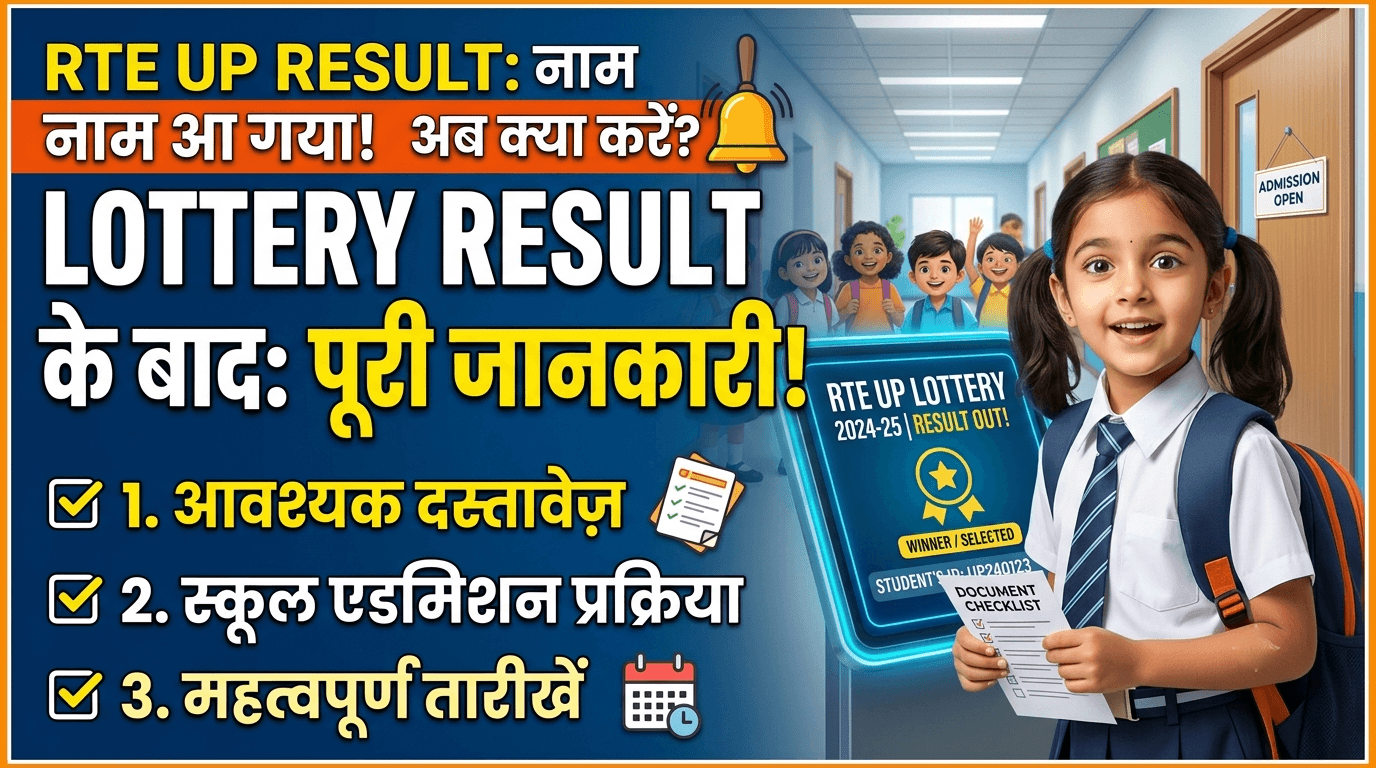
The RTE UP lottery result 2026 has been announced, and now the biggest question on every parent’s mind is: “What should I do next?”
This comprehensive guide will walk you through every step you need to take after checking your child’s lottery result—from downloading the allotment letter and gathering documents to visiting the school and completing admission formalities.
If your child has been selected in the UP RTE lottery, you must immediately download the allotment letter from the official portal rte25.upsdc.gov.in and report to the allotted school within the specified deadline, or your child’s seat will be cancelled. Missing this deadline is the most common mistake parents make, and it leads to thousands of seats going vacant every year.
With over 1.95 lakh seats allocated across Uttar Pradesh this year and more than 4.44 lakh applications received, the competition is intense. But winning the lottery is only half the battle—the real challenge begins now.
RTE UP Admission Documents List: Mandatory Checklist
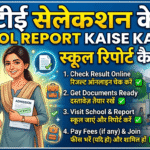
Step 1: How to Check Your UP RTE Lottery Result 2026
The first step is to verify your child’s selection status on the official government portal.
Official Website for Checking Result
The only authorized website to check the UP RTE lottery result is rte25.upsdc.gov.in. Do not rely on any third-party websites or unofficial portals that may provide incorrect or outdated information. Always use the government’s official platform to ensure accuracy and security.
Step-by-Step Guide to Check Your Status
Follow these simple steps to check your child’s lottery result:
- Open your browser and go to rte25.upsdc.gov.in
- Look for the “Student Application Status” option in the left menu
- Select your district from the dropdown list
- Enter your Registration ID and the child’s date of birth
- Type the captcha code correctly
- Click on the “Search” button
Within seconds, your child’s application status will appear on the screen. The status will show one of three results: Selected, Not Selected, or Pending.
Understanding the Lottery Number
When your child is selected, the system generates a unique lottery number. This number represents the sequence in which your child was selected through the randomization process. The lottery system is completely computerized and transparent, ensuring fairness for all applicants.
Keep this number safe as you will need it for downloading the allotment letter and for all future correspondence with the school and education department.
SMS Alerts and Official Communication
The government sends SMS notifications to selected parents. However, these messages can sometimes be delayed or may not reach all parents due to network issues or incorrect mobile numbers in the application. Therefore, you should never rely solely on SMS alerts.
Make it a habit to check the official portal at least once every day. The portal is the most reliable source of information and will always reflect the latest status of your application.
Step 2: What to Do Immediately After Selection
If your child has been selected in the lottery, congratulations! Now comes the most critical phase—taking prompt action to secure the seat.
Download the Allotment Letter Immediately
The allotment letter (also called the admission order) is the most important document you will need. Without this letter, the school will not process your child’s admission.
Here’s why you must download it immediately:
- The download option remains available only for a limited period
- You need this letter for document verification at the school
- It contains important details like your child’s name, allotted school, and reporting deadline
Action Steps:
- Log in to rte25.upsdc.gov.in
- Find the “Download Allotment Letter” option
- Save the PDF file to your phone and computer
- Take at least 3-4 printouts of the letter
- Keep one copy in your bag, one at home, and one with your important documents
Understand the Reporting Deadline
The biggest mistake that parents make is not paying attention to the reporting deadline. Every year, thousands of RTE seats remain vacant simply because parents fail to report to the school on time.
The UP RTE admission process happens in three phases:
| Phase | Application Dates | Lottery Date | Enrollment Order Date |
|---|---|---|---|
| Phase 1 | February 2-16, 2026 | February 18, 2026 | February 20, 2026 |
| Phase 2 | February 21 – March 7, 2026 | March 9, 2026 | March 11, 2026 |
| Phase 3 | March 12-25, 2026 | March 27, 2026 | March 29, 2026 |
After receiving the allotment letter, you have approximately 7 to 10 days to report to the school and complete the admission formalities. If you miss this deadline, your child’s seat will be cancelled and offered to a child on the waiting list.
Important Note:
Do not wait until the last day to visit the school. Go as early as possible. If there are any document issues, you will have time to resolve them before the deadline.
Visit the Allotted School
Before visiting the school:
- Call the school and confirm the working hours
- Ask which official you should meet (Principal, Admission Coordinator, or Administrative Officer)
- Confirm if they are accepting RTE admissions on that day
- Ask about the school’s uniform requirements, book list, and other essentials
When you visit the school, carry all original documents along with photocopies. Dress appropriately and be polite to the school staff. Remember, you are representing your child and your family.
Step 3: Complete Document Verification
This is perhaps the most critical part of the entire process. Incomplete or incorrect documents are the second biggest reason why admissions get rejected.
Complete Documents Checklist
Here is a complete list of all documents you need to carry for verification:
| Document Type | Issuing Authority | Important Notes |
|---|---|---|
| RTE Allotment Letter | rte25.upsdc.gov.in | Downloaded from the official portal |
| Child’s Birth Certificate | Municipal Corporation / Gram Panchayat | Proof of age for class eligibility |
| Income Certificate | Tehsildar / Revenue Department | For EWS category – annual income below ₹1,00,000 |
| Aadhaar Card (at least one parent) | UIDAI | Child’s Aadhaar is NOT mandatory anymore |
| Residence Proof | Multiple sources | Ration card, voter ID, electricity bill, water bill, etc. |
| Caste Certificate (if applicable) | Tehsildar / District Magistrate | For SC/ST/OBC category applicants |
| Disability Certificate (if applicable) | Chief Medical Officer | Minimum 40% disability required |
| Passport-sized Photographs | – | 2-3 copies for school records |
Aadhaar Requirement – What Has Changed?
The Uttar Pradesh government has relaxed the Aadhaar requirement for RTE admissions. Earlier, the child’s Aadhaar card was mandatory. Now:
- The child’s Aadhaar is no longer required
- At least one parent’s Aadhaar is required
- Parent’s Aadhaar is needed primarily for receiving the ₹5,000 annual government scholarship
This change was introduced in the 2025-26 academic session and continues for 2026-27 admissions.
Income Certificate Guidelines
For the EWS (Economically Weaker Section) category, your family’s annual income must be less than ₹1,00,000. This income certificate must be issued by the Tehsildar or the Revenue Department.
Important points to remember:
- The income certificate should not be more than 6 months old
- It should clearly mention the annual income of all family members
- The certificate must have the official stamp and signature of the issuing authority
- Do not submit forged or fake documents—this is a criminal offense under Section 13 of the RTE Act 2009
Pro Tip:
If you don’t have an income certificate yet, visit your local Tehsildar office immediately. The process can take 5-7 days, so don’t wait until the last moment.
Step 4: Confirm Admission at the School
Once you have all your documents ready, visit the school to complete the admission process.
What Happens During School Verification
When you arrive at the school, the admission process typically involves:
- Document Verification: The school official will check your original documents and take photocopies for their records. They will return the originals to you immediately.
- Admission Form Filling: You will need to fill the school’s admission form with your child’s details.
- Registration: The school will register your child’s name in the admission register and generate an admission number.
- UDISE ID Generation: The school must generate a UDISE ID for your child. Without this, the school will not receive government reimbursement for your child’s education.
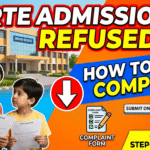
What If the School Denies Admission?
Under Section 12(1)(c) of the RTE Act 2009, private non-minority schools must reserve 25% of their seats for EWS and disadvantaged group children. If a school refuses admission to a child selected through the lottery, it is a violation of the law.
If a school denies admission, you have the following options:
- File a Complaint with the DEO: Contact the District Basic Education Officer (DEO) in your district. They have the authority to take action against schools that violate the RTE Act.
- Appeal Under Section 13 of RTE Act: This section provides for penal provisions against schools that refuse admission without valid reason. The school can face a fine and even cancellation of its recognition.
- Contact the District Monitoring Committee: This committee is headed by the District Magistrate and has the power to intervene in such matters.
- Use RTI: If the school doesn’t respond, you can file an RTI application to get information about the action taken by the education department.
Expert Insight:
Mr. Prabhakar Tripathi, former District Basic Education Officer, Lucknow, advises: “RTE Act is not just a guideline—it’s a law. Selected children have a legal right to admission. If a school refuses, parents should immediately approach the DEO’s office. We have taken strict action against many schools in the past and forced them to admit RTE-quota children.”
Fees and Reimbursement Process
Under the RTE Act:
- No fees can be charged to selected children
- The government reimburses schools up to ₹450 per child per month for 12 months
- Parents receive ₹5,000 annually directly in their Aadhaar-linked bank account for uniforms and books
- This reimbursement is released only after the school generates the UDISE ID
Step 5: What If Your Child Was NOT Selected?
If your child was not selected in the lottery, do not lose hope. The RTE admission process is designed to give multiple opportunities.
Check the Waiting List
After each lottery phase, a waiting list is published. Why should you check the waiting list?
- Many selected parents fail to complete the admission process on time
- Their seats become available for waiting list candidates
- In the 2025-26 session, 15,679 new admissions were completed in just 4 days after the government started strict monitoring
Many of these were waiting list candidates who got seats when others missed their deadlines.
Prepare for the Next Phase
The RTE admission process has three phases in total:
- Phase 1: February 2-16, 2026
- Phase 2: February 21 – March 7, 2026
- Phase 3: March 12-25, 2026
If you weren’t selected in Phase 1, you must reapply for Phase 2. Your previous application does not automatically carry forward to the next phase. Check the official portal regularly for new application dates and announcements.
Consider Government Schools
Remember that under Article 21A of the Indian Constitution, every child between the ages of 6 and 14 has the right to free and compulsory education. If you don’t get a seat in a private school under the RTE quota, you can always seek admission in a government school.
Government schools are legally bound to admit your child, and they are not allowed to charge any fees. Many government schools in Uttar Pradesh have improved significantly in recent years and offer quality education with good facilities.
Expert Insight:
Dr. Sunita Sharma, education expert and RTE activist, explains: “Many parents don’t realize that even if their child isn’t selected in the RTE lottery, they still have a legal right to education in government schools. Article 21A ensures this. Parents should not feel defeated—government schools are a perfectly valid option.”
Complete Documents Checklist (Printable Version)
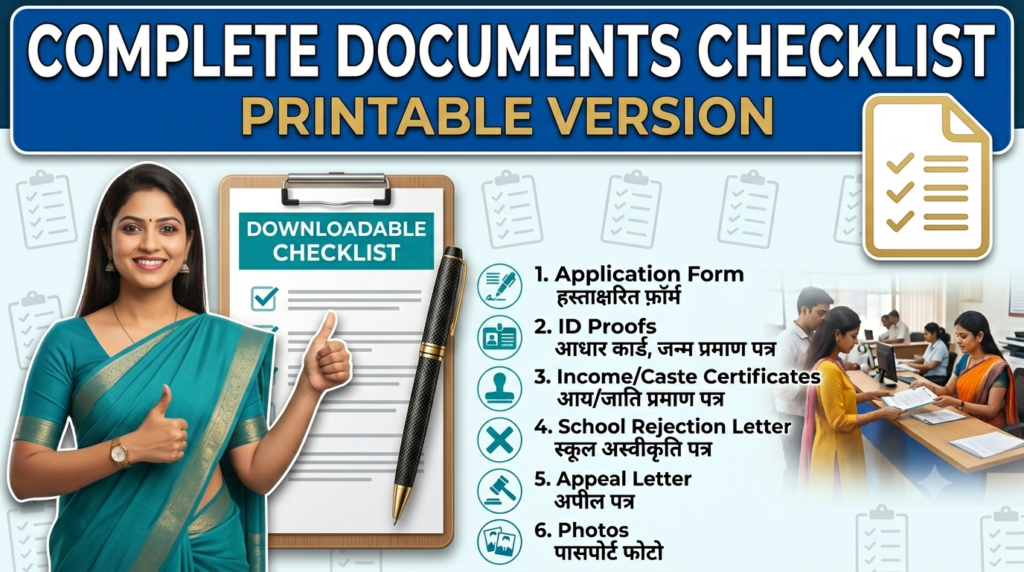
Before visiting the school, check off these items:
- [ ] RTE Allotment Letter – Downloaded from rte25.upsdc.gov.in
- [ ] Child’s Birth Certificate – Original + 2 photocopies
- [ ] Income Certificate (EWS category) – From Tehsildar
- [ ] Aadhaar Card (at least one parent) – Original + photocopy
- [ ] Residence Proof – Ration card / Voter ID / Electricity bill
- [ ] Caste Certificate (if applicable) – From Tehsildar / DM
- [ ] Disability Certificate (if applicable) – From CMO (40%+)
- [ ] Passport-sized Photographs – 3 copies
- [ ] Any other documents requested by the school
Common Mistakes to Avoid
Thousands of parents lose their child’s RTE seat every year due to simple mistakes. Here are the most common ones and how to avoid them:
1. Missing the Reporting Deadline
What happens:
Parents relax after the lottery result and forget to check the deadline. They report late, and the seat is given to someone else.
How to avoid:
Mark the deadline on your calendar as soon as you download the allotment letter. Visit the school at least 3-4 days before the last date.
2. Incomplete or Incorrect Documents
What happens:
Parents carry documents that are not in the proper format, issued by the wrong authority, or expired.
How to avoid:
Check each document carefully. Verify that income certificates are from the Tehsildar, not from a local clerk. Ensure the birth certificate is from the Municipal Corporation or Gram Panchayat.
3. Ignoring SMS and Portal Updates
What happens:
Parents wait for an SMS and don’t check the portal. The SMS doesn’t arrive, and they miss important updates.
How to avoid:
Check the official portal every single day. The portal is the most reliable source of information.
4. Forgetting to Download the Allotment Letter
What happens:
Parents know they are selected but don’t download the letter, thinking they can download it later. The download window closes.
How to avoid:
Download the letter the moment you see the selection status. Save it in multiple places.
5. Not Understanding Renter Eligibility Rules
What happens:
In 2026, a new rule was introduced: Children of renters are not eligible for RTE admission. Many parents are unaware of this and apply, only to be rejected.
How to avoid:
If you live in a rented house, confirm your eligibility status before applying or check with the DEO office.
Latest Updates for 2026–27
The RTE admission process has seen several important changes recently. Here are the key updates every parent should know:
1. Aadhaar Rule Relaxation
As mentioned earlier, the government has made Aadhaar optional for the child. Only one parent’s Aadhaar is required for receiving the government scholarship. This relaxation was introduced in 2025 and continues for the current session.
2. New Age Criteria for Class 1
Following the National Education Policy 2020, the age criteria have been standardized:
| Class | Age as of April 1, 2026 |
|---|---|
| Nursery | 3-4 years |
| LKG | 4-5 years |
| UKG | 5-6 years |
| Class 1 | 6-7 years |
| Class 2 | 7-8 years |
This change affects approximately 40 lakh children across Uttar Pradesh.
3. Phase-Wise Schedule for 2026-27
The government has announced three phases for the 2026-27 academic session:
| Phase | Application Dates | Lottery Date | Enrollment Order |
|---|---|---|---|
| Phase 1 | February 2-16, 2026 | February 18, 2026 | February 20, 2026 |
| Phase 2 | February 21 – March 7, 2026 | March 9, 2026 | March 11, 2026 |
| Phase 3 | March 12-25, 2026 | March 27, 2026 | March 29, 2026 |
4. Renter Ineligibility Rule (New)
Effective from 2026-27, children of parents living in rented accommodations are NOT eligible for RTE admission. This is a significant policy change that affects thousands of urban families. Only families owning a house can apply.
5. Reimbursement and Financial Support
- The government has tightened verification for reimbursement
- Schools must generate UDISE ID for each child
- Fake documents will lead to legal action under Section 13 of RTE Act
- Block Education Officers will inspect schools every three months to ensure compliance
Frequently Asked Questions (FAQ)
Q1: What should I do immediately after checking the UP RTE lottery result?
Immediately download the allotment letter from rte25.upsdc.gov.in. Then, gather all required documents and visit the allotted school within the reporting deadline. Do not wait for an SMS—the portal is your most reliable source of information.
Q2: How do I download the allotment letter for UP RTE 2026?
Visit rte25.upsdc.gov.in, click on “Student Application Status,” enter your district, Registration ID, and captcha. If selected, the download option for the allotment letter will appear. Save the PDF and take multiple printouts.
Q3: What documents are required for RTE admission?
You need: (1) RTE allotment letter, (2) child’s birth certificate, (3) income certificate (EWS), (4) parent’s Aadhaar, (5) residence proof, (6) caste certificate (if applicable), (7) disability certificate (if applicable), and (8) passport-sized photographs.
Q4: What is the deadline to report to the school after the lottery result?
You have approximately 7-10 days from the lottery date to report to the school. For Phase 1 2026, the lottery was on February 18 and the enrollment order was issued on February 20. Check the exact date on your allotment letter.
Q5: What if I miss the school reporting deadline?
If you miss the deadline, your child’s seat will be cancelled and offered to a child on the waiting list. This is the most common reason for seat loss, so mark the date on your calendar and visit the school as early as possible.
Q6: What if the school refuses admission after lottery selection?
Under Section 12(1)(c) of the RTE Act, the school cannot refuse admission to a selected child. If they do, file a complaint with the District Basic Education Officer (DEO). You can also use RTI to get information about action taken.
Q7: Is the child’s Aadhaar card mandatory for RTE admission?
No. The government has relaxed this rule. The child’s Aadhaar is no longer required. However, at least one parent’s Aadhaar is needed for receiving the ₹5,000 annual government scholarship.
Q8: What if my child was not selected in the lottery?
Check the waiting list—many seats become available when selected candidates don’t complete the admission process. Also, apply for Phase 2 and Phase 3 as they open. You can also consider government schools under Article 21A.
Q9: What is the income limit for EWS category in UP?
For EWS category, the family’s annual income must be less than ₹1,00,000. The income certificate must be issued by the Tehsildar and should not be more than 6 months old.
Q10: How many RTE seats are available in UP for 2026-27?
A total of 1,95,740 seats have been allocated across Uttar Pradesh. District-wise allocation varies—for example, Lucknow has 16,784 seats while Kanpur has 9,650 seats.
Q11: Who pays the school fees under RTE?
No fees can be charged to RTE-quota children. The government reimburses schools up to ₹450 per child per month for 12 months. Additionally, parents receive ₹5,000 annually in their bank account for uniforms and books.
Q12: Can I change schools after RTE lottery selection?
Generally, it is difficult to change schools after admission. However, if the allotted school refuses admission or doesn’t provide proper facilities, you can approach the DEO for permission to transfer. This is granted only in exceptional cases.
Q13: How much financial assistance does the government provide under RTE?
Parents receive ₹5,000 annually directly in their Aadhaar-linked bank account. This amount is meant for uniforms, books, and stationery. It is transferred directly by the government, not through the school.
Q14: Are children of renters eligible for RTE admission in 2026?
No. As per the new rule effective from 2026-27, children whose parents live in rented accommodations are NOT eligible for RTE admission. Only families with their own house can apply. This rule applies across all districts of Uttar Pradesh.
Conclusion
Checking your UP RTE lottery result is just the beginning of the journey. The most critical phase begins after you see the “Selected” status. Your action plan must be immediate and systematic:
- Download the allotment letter from rte25.upsdc.gov.in
- Gather all required documents with the correct issuing authorities
- Visit the school well before the reporting deadline
- Complete verification and admission formalities within the time limit
Remember the golden rule of RTE admissions: Selection wins the lottery, but timely action secures the seat. Thousands of seats go vacant every year simply because parents don’t complete the post-lottery process on time.
If your child wasn’t selected, keep checking the waiting list and apply for the next phases. And always remember that under Article 21A of the Indian Constitution, every child between 6 and 14 years has the right to free education—whether in a private school under RTE or in a government school.
Your child’s future is in your hands. Act now, act fast, and secure their seat today!
Take Action Today
Visit the official portal rte25.upsdc.gov.in right now to check your status, download the allotment letter, and begin the admission process. If you have any questions, contact your District Basic Education Office or call the RTE helpline.
Don’t wait—every day counts in securing your child’s RTE admission!


4 thoughts on “What to Do After RTE UP Lottery Result?”