
Introduction
UP RTE New Registration: Complete Process, Eligibility & Dates
Are you looking to get your child admitted to a private school in Uttar Pradesh for free? The UP RTE (Right to Education) scheme makes this possible. Under this government initiative, 25% of seats in private schools are reserved for children from economically weaker sections (EWS) and disadvantaged groups. This means your child can receive quality education in a private school without paying any fees.
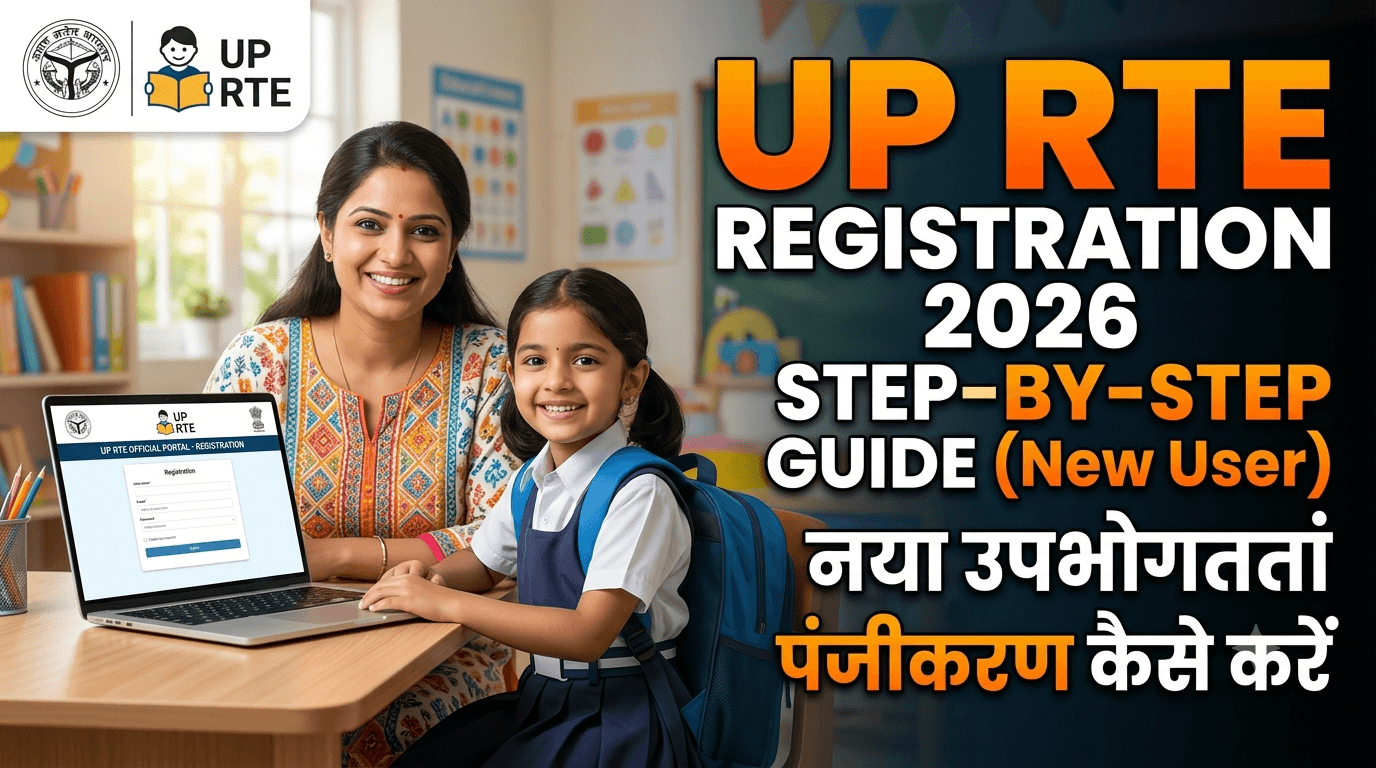
The registration process for the 2026–27 academic session is conducted completely online through the official portal rte25.upsdc.gov.in. In this guide, we will walk you through the entire UP RTE new user registration process, eligibility criteria, required documents, important dates, and common mistakes to avoid.
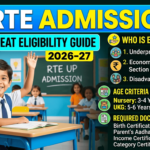
Eligibility Criteria
To qualify for the UP RTE scheme, applicants must meet the following criteria:
- Residency: The applicant must be a domicile of Uttar Pradesh.
- Income Limit: The annual family income must be less than ₹1 Lakh.
- Age Limit: For Pre-Primary, the child should be 3–5 years old. For Class 1, the child should be 6–7 years old (as of April 1, 2026).
- Category: Candidates must belong to EWS, SC, ST, OBC, or other socially disadvantaged groups (including orphans, children with disabilities, or children of single parents).
Required Documents
Keep the following documents scanned and ready before starting your registration:
- Passport-size photograph of the child.
- Child’s Birth Certificate or Aadhaar Card.
- Parent’s Income Certificate (issued by a competent authority).
- Residential Proof (Aadhaar, Voter ID, or Electricity Bill).
- Caste Certificate (if applicable).
Important Dates & Status
Note: The admission cycle for 2026–27 was conducted in four rounds between December 2025 and March 2026. All primary rounds are currently complete. Parents can continue to check the official portal rte25.upsdc.gov.in for any late updates or to verify the status of previous applications using their Registration ID.
Common Mistakes to Avoid
To ensure your application is not rejected, please keep these tips in mind:
- Accuracy: Ensure the details entered in the portal (Name, DOB) match the documents exactly.
- Distance Norms: Ensure you are choosing schools within the required radius (1 km for Class 1) to improve allotment chances.
- Document Clarity: Make sure all uploaded files are clear, readable, and not blurry.
- Verification: Once registered, keep track of the BSA verification status on the portal.
UP RTE Phase 3: Last Chance Admission Tips
What is the UP RTE 25% Free Admission Scheme?
The Right to Education (RTE) Act, 2009, mandates that every child between the ages of 6 and 14 has the right to free and compulsory education . A key provision, Section 12(1)(c) of the RTE Act, requires all private unaided schools to reserve at least 25% of seats in Class I (or pre-primary classes) for children belonging to weaker sections and disadvantaged groups .
In Uttar Pradesh, this scheme is implemented by the Basic Education Department. For the 2026–27 academic session, a total of 1,95,740 seats were allotted in private schools under this quota . This initiative aims to provide equal educational opportunities to children from economically weaker and socially disadvantaged backgrounds .
Key benefits for parents:
- No fees – Your child gets free education up to Class VIII
- No donation or hidden charges – schools cannot demand any fees
- Reimbursement to schools – government pays ₹450 per child per month
- Direct benefit to parents – ₹5,000 per year for books and uniform
Official RTE portal: rte25.upsdc.gov.in
UP RTE 2026 Important Dates – 3-Phase Schedule
The admission process for 2026–27 is conducted in three phases. Here are the complete dates :
UP RTE Admission Schedule 2026-27
| Phase | Application Dates | Lottery Date |
|---|---|---|
| Phase I | 02 February – 16 February 2026 | 18 February 2026 |
| Phase II | 21 February – 07 March 2026 | 09 March 2026 |
| Phase III | 12 March – 25 March 2026 | 27 March 2026 |
Why apply in Phase I?
The first phase has the highest number of seats available. If you miss Phase I or are not selected, you can apply again in Phase II and III.
RTE UP Admission Phase 3 Dates – Apply Kab Tak?
Who is Eligible for UP RTE Admission 2026?
Before starting the registration, check if your child meets the eligibility criteria.
Age Criteria (as of 1 April 2026)
Your child’s age is calculated as on 1 April 2026 :
Age Eligibility Criteria (2026-27)
| Class | Minimum Age | Maximum Age |
|---|---|---|
| Nursery | 3 years | 4 years |
| LKG | 4 years | 5 years |
| UKG | 5 years | 6 years |
| Class 1 | 6 years | 7 years |
Important Note: If your child’s age is less than or more than the specified limit, the registration will be cancelled. Double-check the age before applying.
Category Eligibility
Children from the following categories are eligible :
- Economically Weaker Section (EWS) – annual family income less than ₹1 lakh
- SC/ST/OBC – socially and educationally backward classes
- Children with disabilities
- Orphan children
- Children of HIV/cancer patients
- Children of widows or elderly pensioners
- BPL/Antyodaya ration card holders
How to Register on UP RTE Portal – Step-by-Step Guide
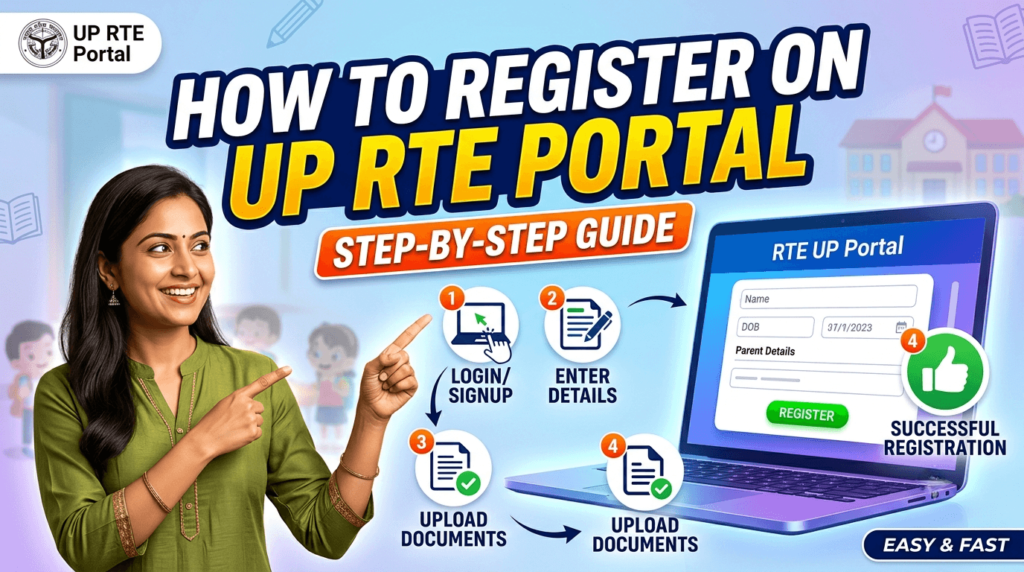
Follow these simple steps to complete your UP RTE new user registration for 2026:
Step 1: Visit the Official Portal
Go to the official UP RTE website: rte25.upsdc.gov.in .
Note: This is the only official portal. Do not apply on any other website – they may be fake.
Step 2: Click on “New Student Registration”
On the homepage, click on the “Online Application / Student Login” link. You will see two options :
- “New Student Registration” – Click this if you are applying for the first time
- “Student Login” – Use this if you already have an Application ID to check status
Step 3: Fill Child’s Personal Details
Enter your child’s details carefully:
- Full name (as on birth certificate)
- Date of birth (DOB)
- Category (SC/ST/OBC/EWS/General)
- Address (ward or gram panchayat)
Pro Tip: Ensure the DOB is accurate – it determines your child’s eligibility. Wrong DOB = cancelled application.
Step 4: Fill Parent/Guardian Details
Now enter parent/guardian information:
- Parent’s name
- Mobile number
- Aadhaar number – Only one parent’s Aadhaar is required. Child’s Aadhaar is not mandatory for 2026 admissions .
Step 5: Upload Required Documents
You need to upload scanned copies of documents. For a smooth upload:
- File format: JPG or PDF
- File size: Keep between 100 KB to 200 KB
- Documents must be clear and readable
Step 6: Select Up to 10 Schools
Choose up to 10 neighbourhood schools from your ward or gram panchayat .
School selection tip: Rank schools in order of preference. Your top choice should be #1. Use all 10 options to increase your chances of selection.
Step 7: Preview and Submit
Important: Preview the entire form before final submission. Check:
- Child’s name, DOB, category
- Parent details and Aadhaar
- Uploaded documents
Once everything is correct, click “Final Submit”. You will receive an Application Number – save it for future reference.
Step 8: Take a Printout
After submission, take a printout and save the PDF of your application form. This is important for future reference.
Documents Required for UP RTE Registration
Here is the complete document checklist for 2026 admission for UP RTE New User Registration:
Required Documents for UP RTE Admission
| Document | Who Needs It? |
|---|---|
| Aadhaar of either parent | Mandatory for all |
| Birth certificate | Mandatory for all |
| Income certificate | EWS category |
| Caste certificate | SC/ST/OBC |
| Residence certificate | All applicants (to prove neighbourhood) |
| Ration card | BPL/Antyodaya families |
| Disability/pension certificate | If applicable |
| Bank account details | For receiving DBT of ₹5,000/year |
Important Note:
Child’s Aadhaar is not required for registration . This change was made to remove barriers for families facing difficulties in Aadhaar generation for young children .
How the UP RTE Lottery System Works
Admissions under RTE are done through a two-stage online lottery system to ensure complete transparency :
Stage 1 – Randomization
All verified applications are shuffled online, and each gets a lottery number.
Stage 2 – Allotment
Schools are allotted in batches of 100 based on the lottery number in ascending order and parent preferences.
Final Approval
The final list is approved by the District Magistrate. Selected parents receive SMS confirmation.
Key fact: In 2026, 4,44,771 applications were received for 1,95,740 seats across UP .
What Happens After Selection?
If your child is selected in the lottery :
- You will receive an SMS notification
- You must complete admission within the deadline
- No fees can be charged by the school
- The government reimburses the school: ₹450 per child per month (for 12 months)
- You receive ₹5,000 per year directly in your bank account for books and uniform
- Admission is free up to Class VIII
Know your rights: If any school demands money or extra documents, report it immediately. Action under Section 13 of the RTE Act will be taken, including possible withdrawal of school recognition .
Common Mistakes to Avoid
Common Mistakes to Avoid in UP RTE Registration
| Mistake | How to Avoid |
|---|---|
| Wrong age entry | Calculate age as on 1 April 2026 |
| Clicking “Student Login” instead of “New Registration” | New users must click “New Student Registration” |
| Uploading wrong/large documents | Keep file size 100-200 KB, use JPG/PDF |
| Selecting few schools | Use all 10 options to increase chances |
| Not taking printout | Save printout and PDF after submission |
| Applying from wrong location | School must be in your ward/gram panchayat |
| Fake documents | This can lead to legal action |
Latest Updates for 2026–27 Session
Here are the key changes for 2026 admissions :
- Aadhaar Relaxed: Only one parent’s Aadhaar required; child’s Aadhaar is not mandatory
- Online Process: Entire admission process is online through rte25.upsdc.gov.in
- Two-Stage Lottery: New system for greater transparency
- Two-Tier Verification: Documents verified first by BEO, then by BSA
- No Fees: Schools cannot charge any fees from RTE students
Frequently Asked Questions (FAQ)
Q1: How to do new registration on UP RTE portal 2026?
Visit rte25.upsdc.gov.in, click “New Student Registration,” fill child and parent details, upload documents, select 10 schools, and submit. Save your Application Number.
Q2: What documents are required for UP RTE admission 2026?
Required documents include: parent’s Aadhaar, birth certificate, income/caste certificate, residence proof, ration card (if applicable), and pension/disability certificate (if applicable).
Q3: Is Aadhaar mandatory for UP RTE 2026?
No. Child’s Aadhaar is not mandatory. Only one parent’s Aadhaar is required .
Q4: How to check UP RTE lottery result 2026?
On the lottery date, go to rte25.upsdc.gov.in, click “Student Login,” enter your Application Number, and check the result. Selected parents also receive SMS.
Q5: What is the income limit for UP RTE EWS?
The annual family income must be less than ₹1 lakh for EWS category.
Q6: Can I apply in Phase II if I miss Phase I?
Yes. If you miss Phase I or are not selected, you can apply in Phase II and Phase III .
Q7: Is there any application fee for UP RTE?
No. The registration process is completely free for all categories.
Q8: How many schools can I choose in UP RTE?
You can select up to 10 schools from your neighbourhood (ward/gram panchayat) .
Q9: What is the age limit for UP RTE Nursery?
For Nursery, the child must be 3 to 4 years old as on 1 April 2026 .
Q10: What to do after selection in UP RTE?
Complete admission within the deadline. No fees are required. You will receive ₹5,000 per year in your bank account for books and uniform.
Q11: How does document verification happen?
Documents are verified first by the Block Education Officer (BEO), then by the District Basic Education Officer (BSA) .
Q12: Are children from rented homes eligible?
For 2026 admissions, please check the latest guidelines from the official portal. Neighbourhood residence is mandatory.
Expert Tips for a Successful UP RTE Application
From Government Education Officials:
“The provision of 25 per cent reservation in entry-level classes of private schools under RTE provides children from deprived and economically weaker sections of society with equal and quality educational opportunities. Ensuring the Right to Education for every eligible child in the state is our highest priority.” – Sandeep Singh, Basic Education Minister, Uttar Pradesh
“To make the RTE admission process transparent and simple, the schedule of all stages has been released. Through online application, verification, and the lottery system, it will be ensured that eligible children get admission to private schools within the stipulated time.” – Monika Rani, Director General, School Education, UP
Conclusion
The UP RTE New User Registration: Step-by-Step Guide is simple and completely online. Here are the key takeaways:
- Apply early – Phase I has the most seats
- Check eligibility – Age, income, and category criteria
- Keep documents ready – Scanned copies in the right format
- Select 10 schools – Increase your chances of selection
- Save your Application Number – It’s your key to checking the result
👉 Start your application today at rte25.upsdc.gov.in and give your child the gift of quality education!
Helpful Resources
- Official UP RTE Portal: rte25.upsdc.gov.in
- UP Basic Education Department: upbasiceducation.gov.in
- RTE Act 2009 Full Text: mhrd.gov.in





2 thoughts on “UP RTE New User Registration: Step-by-Step Guide”